
EN

DIY: How to Convert an Electric Golf Cart to Solar Power?

Jun.24, 2026


DIY: How to Convert an Electric Golf Cart to Solar Power

Imagine parking your golf cart in the sun and returning hours later with a partially recharged battery—without plugging into the grid.

For golf courses, resorts, farms, campgrounds, and homeowners, solar-powered golf carts are becoming an increasingly attractive way to reduce charging costs and extend driving range.

But can a golf cart really run on solar power?

The answer is yes—but not exactly the way most people think.

This guide explains the engineering behind solar golf cart conversions and how to build a reliable DIY solar charging system.


Can a Golf Cart Run Directly From Solar Panels?

One of the biggest misconceptions is that solar panels can directly power the golf cart motor.

The reality is:

Solar panels produce variable voltage and current depending on sunlight conditions, while golf cart motors require stable power during acceleration, hill climbing, and heavy loads.

The correct system architecture is:

Solar Panel → MPPT Charge Controller → Lithium Battery → Motor Controller → Golf Cart Motor

The battery acts as an energy buffer between the solar panels and the vehicle.

Without a battery, the cart would experience unstable operation whenever sunlight changes.


Understanding Golf Cart Energy Consumption

Before selecting solar panels, you must determine how much energy your golf cart uses.

A typical 4-passenger electric golf cart consumes:

  • 80–120 Wh per mile
  • 15–30 miles per charge
  • 1.5–3.5 kWh per day

A modern 48V 105Ah lithium battery stores approximately:

48V × 105Ah = 5.04 kWh

This provides enough energy for most daily driving needs.


How Much Solar Power Do You Need?

The required solar array depends on daily energy consumption.

For example:

If your golf cart uses 2.5 kWh per day and your location receives 5 peak sun hours:

Required Solar Power:

2.5 kWh ÷ 5 hours = 500W

In practice, system losses should be considered.

Most DIY builders install:

  • 400W–800W solar panels
  • MPPT charge controller
  • 48V lithium battery

This allows the battery to recover a significant portion of daily energy usage.


Roof-Mounted Solar vs Stationary Solar Charging

There are two common approaches.

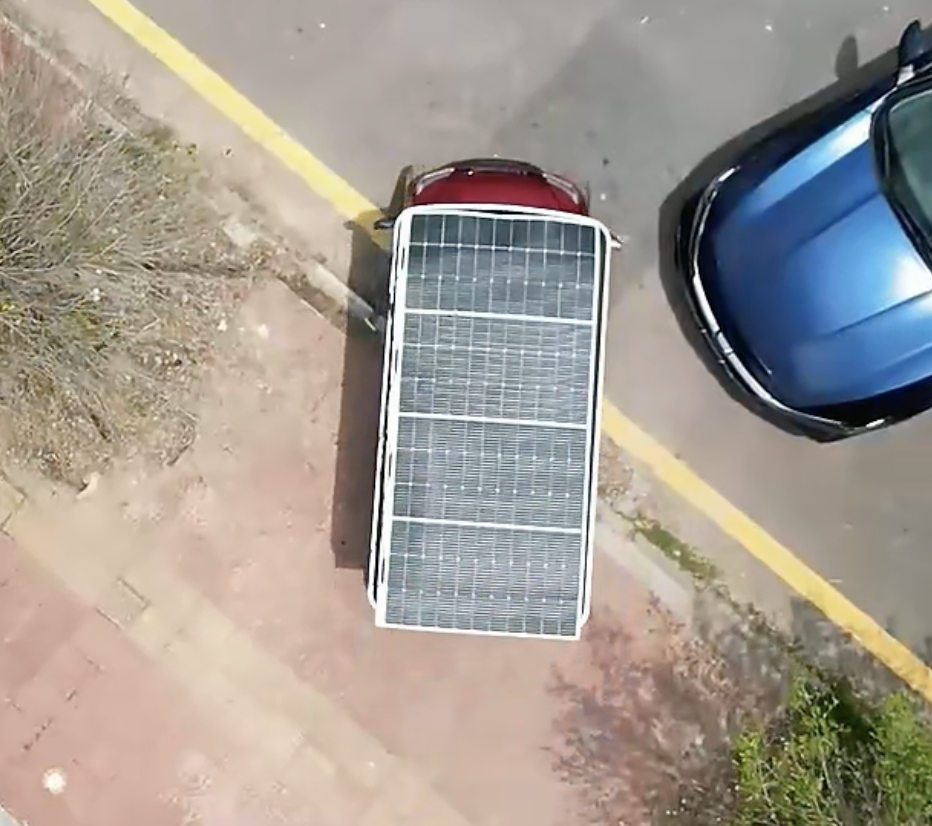
Option 1: Roof-Mounted Solar Panels

Solar panels are installed directly on the golf cart roof.

Advantages:

  • Charging while parked
  • Increased daily range
  • No charging station required

Disadvantages:

  • Limited roof space
  • Typically only 150W–300W capacity
  • Slow charging speed

A roof-mounted system is best viewed as a range extender rather than a full charger.


How to choose solar panels based on your 4seats cart?https://www.wirenergy.net/insights/how-to-choose-the-right-solar-panel-for-your-4-passenger-golf-cart.html


Option 2: Solar Charging Station

A dedicated solar charging station uses larger panels installed on:

  • Carports
  • Garages
  • Farm buildings
  • Storage sheds

Advantages:

  • Faster charging
  • Larger solar arrays
  • Higher efficiency

For most users, this is the preferred solution.


Choosing the Right Lithium Battery

Many solar golf cart projects fail because of inadequate batteries.

The battery must support:

  • High discharge current
  • Frequent cycling
  • Solar charging integration
  • Outdoor operation

Important features include:

✓ LiFePO4 chemistry

✓ Integrated BMS

✓ Bluetooth monitoring

✓ CAN or RS485 communication

✓ Low-temperature protection

✓ IP67 waterproof rating

For example, a 48V 105Ah lithium battery with a 300A BMS can easily handle hill climbing, passenger loads, and solar charging applications.


Learn the battery we used for our solar power golf cart:https://www.wirenergy.net/golf-cart/sentinel-g5.html


Why Lithium Batteries Work Better With Solar

Compared with traditional lead-acid batteries, lithium batteries offer several advantages:

Feature Lead Acid LiFePO4
Charging Efficiency 70–80% 95–99%
Cycle Life 500–1000 4000–8000
Weight Heavy Lightweight
Solar Compatibility Moderate Excellent
Maintenance Required Minimal

Solar systems perform best when paired with lithium batteries because more harvested solar energy is stored instead of wasted.


Common DIY Solar Golf Cart Mistakes

Mistake #1: Undersized Solar Panels

Many users install only 100W–200W of solar.

This may offset self-discharge but provides very limited daily charging.


Mistake #2: Using PWM Controllers

PWM controllers leave significant solar energy unused.

MPPT controllers can increase energy harvest by 15–30%.


Mistake #3: Ignoring Battery Current Requirements

During acceleration and hill climbing, golf carts can demand hundreds of amps.

Some batteries are not designed for these loads.

Always verify:

  • Continuous discharge current
  • Peak discharge capability
  • BMS rating

Mistake #4: No Weather Protection

Outdoor systems should include:

  • Waterproof battery enclosures
  • UV-resistant wiring
  • Corrosion-resistant connectors


Real-World Example

A typical solar golf cart setup may include:

  • 48V 105Ah LiFePO4 Battery
  • 600W Solar Array
  • MPPT Solar Controller
  • Bluetooth Battery Monitoring
  • 300A BMS

Such a system can recover several miles of driving range each sunny day and dramatically reduce dependence on grid charging.


Is a Solar Golf Cart Worth It?

For occasional golfers, the financial savings may be modest.

However, for:

  • Golf courses
  • Resorts
  • Rental fleets
  • Farms
  • Campgrounds
  • Large private properties

Solar charging can significantly reduce electricity consumption and improve operational flexibility.

The biggest benefit is not free energy.

It is having a golf cart that is continuously replenishing energy whenever sunlight is available.


Final Thoughts

Converting an electric golf cart to solar power is one of the most practical DIY renewable energy projects available today.

By combining a properly sized solar array, MPPT controller, and high-quality LiFePO4 battery, users can extend range, reduce charging costs, and increase energy independence.

As lithium battery technology continues to improve, solar-powered golf carts are becoming a realistic solution for both recreational and commercial applications.

The key is designing the system as an integrated energy platform rather than simply attaching solar panels to the roof.


See our installation video:https://www.youtube.com/watch?v=ILEIzup3M5U

Recommended Products

Wiren Shenzhen Co., Ltd.